Building Dead Weight: a devlog
A clerk dies on his birthday
Dead Weight is a point-and-click adventure about Pell Farthing, a junior filing clerk who opens an eighty-year-old envelope on his birthday and is killed by what was inside. He then has to sort out the afterlife, because the man who rows the dead across the river has gone on strike.
I have wanted to make a game like this since I was a kid sitting in front of Monkey Island and King’s Quest. This blog is the build diary: where the idea came from, how the story and puzzles are put together, how the pixel art gets made, and what I am learning along the way. Chapter 1 is fully scripted and in art production now.
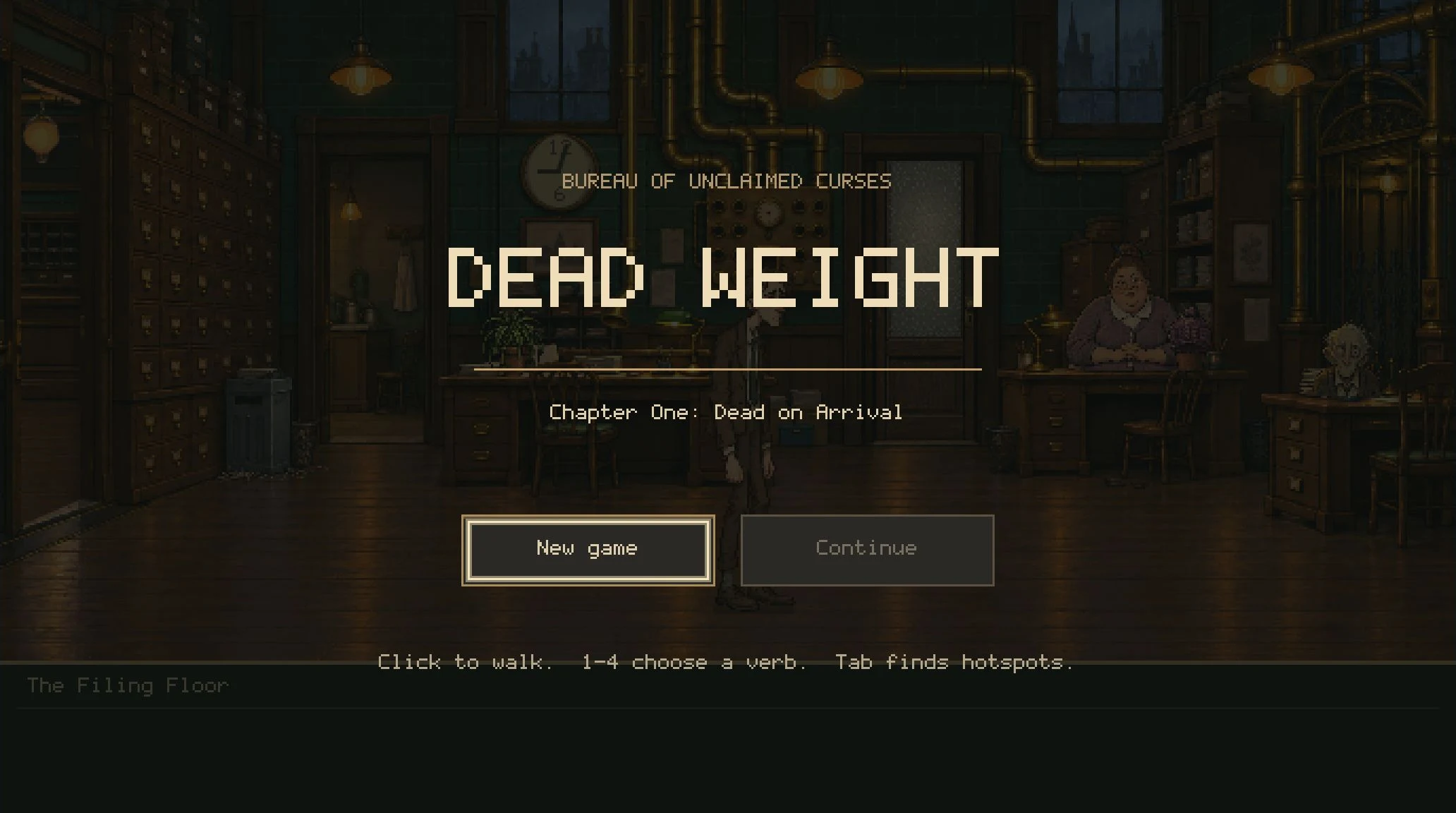
The title screen of the Chapter 1 build, over the Filing Floor at the Bureau of Unclaimed Curses.
Where it came from
The starting brief I wrote for myself was one line: a click-and-play fantasy game in the style of Monkey Island, King’s Quest and Leisure Suit Larry, with magic and dark humour. Those games taught me that a puzzle can be a joke, and that a room full of odd objects is an invitation to try everything on everything.
The tone owes a lot to the comic fantasy I grew up reading, the kind where wizards need permits and gods are petty. I wanted that flavour without borrowing anyone else’s world, so everything in Dead Weight is its own: the city, the cast and the cosmology.
A few things I wanted to bring back from the classics:
- A verb interface. Look, Take, Use and Talk, with a funny answer for almost every combination.
- Fake deaths. Sierra killed you constantly. Dead Weight shows the same death panel, “You have died.”, then a beat, then “…Not yet.” and play resumes. There are six in the first act.
- Pixel art at a fixed resolution. Hand-placed pixels, a limited palette and a chunky interface bar along the bottom.
And one modern comfort: a built-in hint voice. Every puzzle has three escalating hints, so nobody has to reach for a walkthrough.
The story
The world is a coin. Ten thousand years ago two bored gods, Lord Obverse and Lady Reverse, flipped it to settle an argument neither of them remembers. It is still spinning, and everyone lives on it.
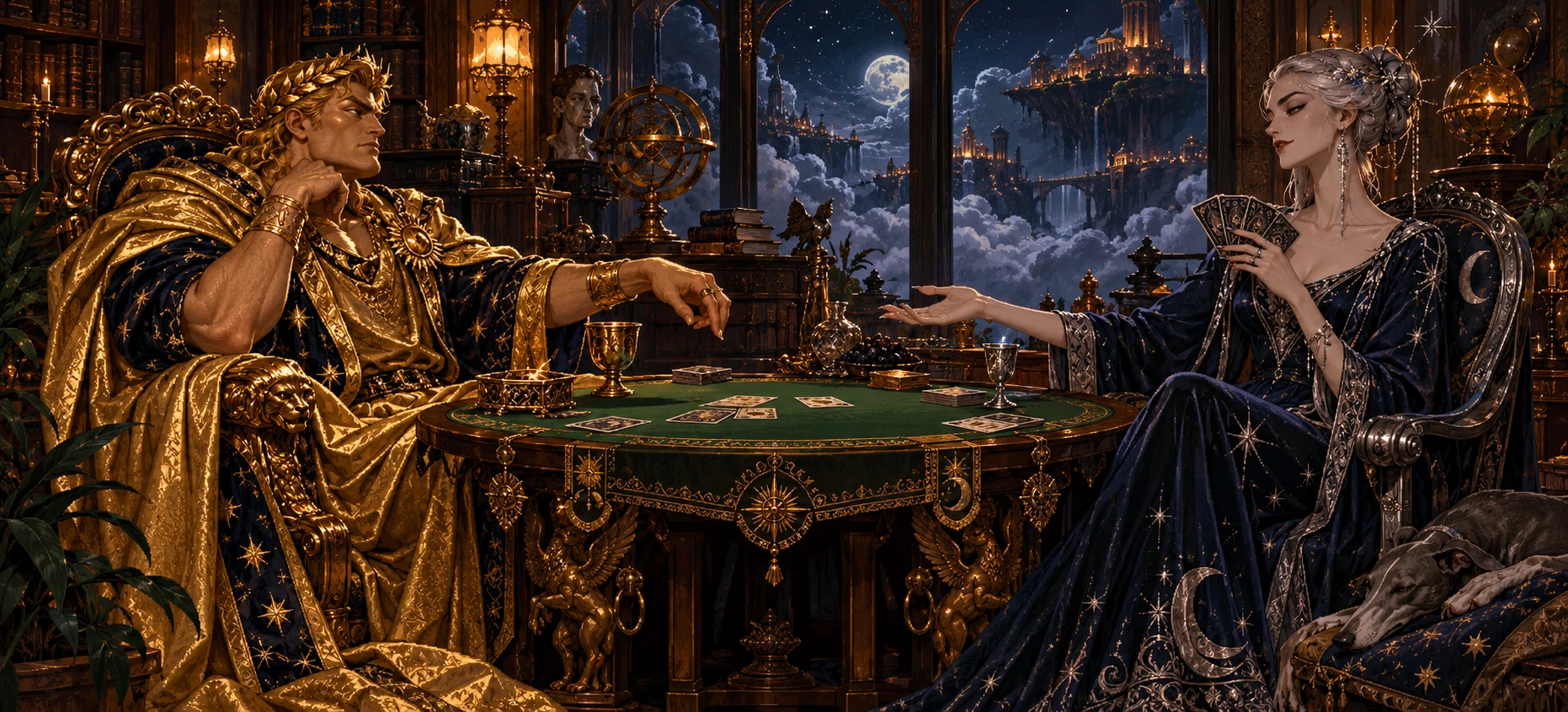
Lord Obverse and Lady Reverse, from the prologue cutscene.
The game is set in Gristle, a damp and gloriously corrupt city on the river Slurry, where magic is licensed and taxed and you need Form 7b to cast a spell. Pell works at the Bureau of Unclaimed Curses, the city’s lost-and-found for curses whose targets died or moved house before they landed. He has no magical talent. His one gift is reading the small print.
The engine of the plot is that souls have weight. Old Nabb, the Ferryman, has gone on strike and is sitting on a picket line by the river. The dead are piling up on one side of the coin, and the world has started to tip. Pell, newly dead, is the one who has to find out why, with Mildred, a small and deeply apologetic curse, along as his companion.
The joke underneath it all: Pell only starts living once he is dead.
The story runs across six chapters plus a prologue and an epilogue. The first three are:
- Dead on Arrival. The Bureau, the envelope and the death.
- The Dead Don’t Get Weekends. Learning the rules of being a ghost.
- Follow the Money. Pell starts asking awkward questions.
Chapter 1 alone has 11 screens, 20 speaking parts and 10 required puzzles.
Making the pixel art
Pixel art was not the first look I tried. I went through flat vector and ink-and-wash first, and both came out too simple, almost childish. The pixel test was the clear winner, because it looked like the games that inspired this one and because it can be refined one pixel at a time.
The frame is 688 by 384 pixels: a 688 by 312 playfield with a 72 pixel interface bar underneath, shown at 2x. Every room, character and animation frame is built to that grid.
I started out generating the art in PixelLab, an AI pixel-art tool. It didn’t work well enough, and I’ve stopped using it. The rest of the pipeline for each screen still holds:
- Brief. Write a detailed prompt for the room or character, including an exact colour palette taken from earlier approved art.
- Generate. Produce the raw room or character art and pick the best result.
- Match the palette. Snap the colours to the project palette so every room feels like the same world.
- Fix and letter. Correct continuity errors (doors in the wrong wall, mostly) and letter the signs in a custom pixel font.
- Cut a clean plate. Remove anything that moves, like a drawer that opens, and rebuild the background behind it so the animated object can sit on top.
The Filing Floor, Pell’s office and the hub of Act 1, went through several rounds before its clean plate was locked. Every Chapter 1 screen, cutscene painting and character prompt is now briefed, and the character sprites are under way, starting with Pell’s walk cycle.
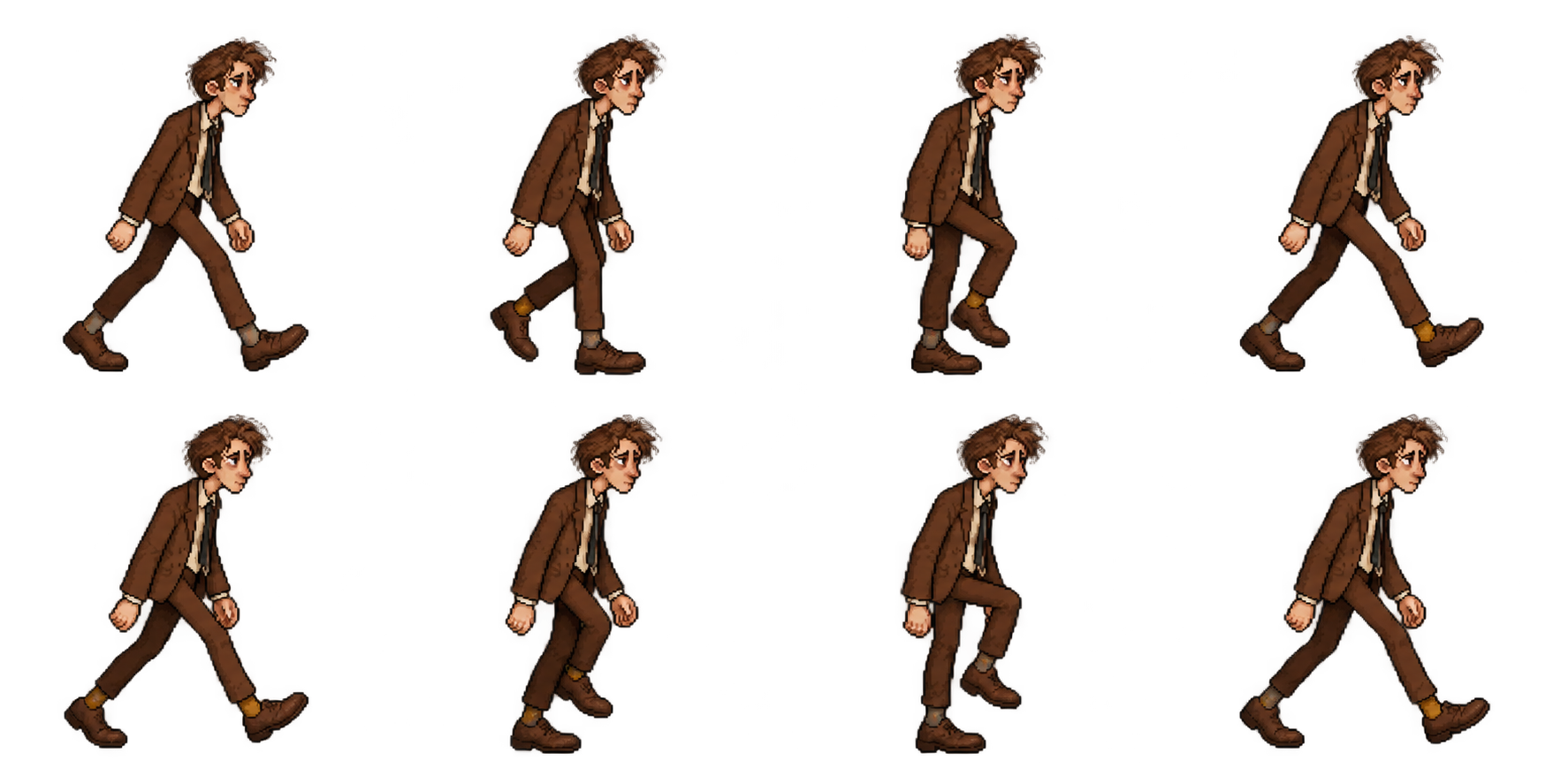
Pell’s walk cycle: eight frames of a man who would rather not be going anywhere.
How ghosts look
Only the dead get the ghost treatment, a pale icy blue. Rooms always stay in full colour.
An early version did the opposite: once Pell dies, the whole world drained to blue so the player felt the shift. I looked at it and dropped it. It made the afterlife feel like a filter, and it said the wrong thing. The point is that the world simply carries on without him. The office is still the office, the kettle is still on, and Pell is the one who no longer fits.
So in the design system, ghostliness is a property of a character or an object, never of a room. The single exception is the moment of death itself, the one beat where the room goes cold with him.
It also changes how you play. Alive, Pell can Look, Take, Use and Talk. Dead, Take always fails (“My hands have become purely decorative.”) and he has to find other ways to move things around.
How it is built, and where it will live
Dead Weight is built with a lot of AI help, and I would rather say so up front. Claude is my writing partner and production assistant: we worked out the six-chapter story together, then wrote every Chapter 1 and 2 screen, hotspot, dialogue branch, puzzle dependency and game flag into one shared design document. A set of small Python tools handles palette matching, clean plates and ghost conversion.
The script is written so a build can be generated from it. The next step is handing the Chapter 1 script, the character prompts and a build brief to a coding model and getting a playable first chapter out the other end.
The game will live on llvls, the browser arcade David and I are building. It will be one game there: Chapter 1 free to play, with Chapters 2 to 6 added later as unlocks inside the same game.
What’s next
The next few posts will follow the work as it happens:
- Finishing the Chapter 1 character sprites, including Pell’s ghost.
- The first playable build of Chapter 1.
- Art and scripting for Chapter 2 and beyond.
If you grew up on these games too, follow along. I will share the rooms as they come together, including the ones that did not work.